独立平台电缆终端杆在强风作用下经常发生破坏,为了优化电缆终端杆几何参数,采用ABAQUS的CFD模块建立了电缆终端杆和流场的数值分析模型,基于双向流固耦合的方法研究了基本风速(30m/s)条件下平均壁厚(9.88mm、11.88mm、13.88mm和15.88mm)、杆高(33m、30m和27m)和锥度(0、1/200和1/100)对电缆终端杆的风振响应的影响。研究结果表明:增加电缆终端杆壁厚、降低主杆高度、增加主杆锥度均能有效抑制强风作用下电缆终端杆的风致振动;不同几何参数条件下电缆终端杆的风振均由低阶振型(第一或第二阶振型)控制;在风向为0°时,高阶振型的贡献随着平均壁厚的增大,杆高的降低和锥度的增大而增大,在风向为90°时,高阶振型的贡献随着平均壁厚的增大,杆高的降低而减小,随锥度的增大变化不明显。
Independent platform cable terminal poles are often subjected to structural damage under strong wind loads. To optimize geometric parameters of cable terminal poles,a numerical model of the cable terminal pole and surrounding flow field was established by using the CFD module in ABAQUS. Based on a two-way fluid-structure in⁃teraction(FSI)approach,the wind-induced vibration response of the terminal pole was investigated under a basic wind speed of 30 m/s, considering variations in average wall thickness(9.88 mm, 11.88 mm, 13.88 mm, and 15.88 mm),pole height(33 m,30 m,and 27 m),and taper ratio(0,1/200,and 1/100). The results indicate that increasing the wall thickness,reducing the height of the main pole,and enlarging the taper ratio of the main pole can effectively suppress wind-induced vibrations of the cable terminal pole under strong winds. The wind-in⁃duced vibration of cable terminal poles under geometric parameters is primarily governed by low-order modes(the first and second modes). When the wind direction is 0°,the contribution of higher-order modes increases with larg⁃er average wall thickness, lower pole height, and greater taper ratio. However, under 90° wind direction, the contribution of higher-order modes decreases with the increase of average wall thickness, the decrease of pole height,while showing little variation with taper ratio.
引言
上海作为我国经济中心和台风频发的超大型沿海城市,电力系统的安全运行直接关系到城市核心功能稳定与社会经济韧性。上海地区110 kV独立平台电缆终端杆杆身长细比较大,对风荷载十分敏感,在强风作用下,电缆终端杆会产生大幅度振动,可能导致杆体失稳和电缆终端金具断裂,给线路安全运行带来极大安全隐患。因此,对目前电缆终端杆的几何参数进行调整以减少电缆终端杆的强风作用下的位移幅值显得十分重要。
在输电塔风振响应的数值模拟研究方面,杨子烨等[1] 等采用ABAQUS有限元软件建立了上海地区的110 kV换向分支杆的风振有限元分析模型,研究了在强风作用的风振响应和Mises应力分布。梁岩等[2] 同样采用ABAQUS有限元软件研究了风攻角和盐渍土对输电塔的腐蚀程度对输电塔风致位移响应以及模态特征的影响。曹枚根等[3] 建立输电塔的有限元模型,以塔顶加速度响应均方根为评价指标,验证了悬挂拉索阻尼器对电塔的风振抑制效果。韩承永等[4] 建立羊角型直线塔的有限元分析模型,研究了不同风向下击暴流作用下羊角型直线塔的动力响应。在对结构流固耦合数值计算研究方面,Nariman等[5-6] 采用ABAQUS软件研究了风速、桥板流线型长度和空气动力粘度对斜拉桥气动性能的影响。雷伟等[7] 基于缩尺气弹模型风洞试验数据,通过计算流体力学的方法,研究了不同风向角条件下钢桥塔涡激振动的发生机理,赵桂峰等[8] 基于Fluent软件研究了在0°和90°两种风向条件下,风速对避雷针不同测点顺风向和横风向应变响应的影响。董国朝等[9] 使用Fluent软件研究了双幅钢箱梁连续梁桥的涡激振动,并将模拟结果与风洞试验进行对比,验证了数值模拟的正确性。张建国等[10] 使用Fluent建立了不同截面边长比的大跨悬索桥矩形吊杆二维有限元模型,研究了风攻角对吊杆风振特性的影响。檀忠旭等[11] 使用CFD软件研究了不同形式和尺寸的中央隔涡板对分体钢箱梁涡激振动的抑制效果,并通过风洞试验验证了模拟结果的正确性。但是目前对于输电钢管塔几何参数对其风振响应影响的双向流固耦合研究还鲜有报道。
针对上述问题,基于双向流固耦合的计算方法,通过ABAQUS有限元软件建立了独立平台电缆终端杆和周围流场的有限元模型,在上海基本风速条件下,研究了不同几何参数(平均壁厚、杆高和锥度)对电缆终端杆位移及模态特征的影响,以期为独立平台电缆终端杆几何参数的重新设计提供参考。
1 双向流固耦合数值建模
1.1 流体计算域建模
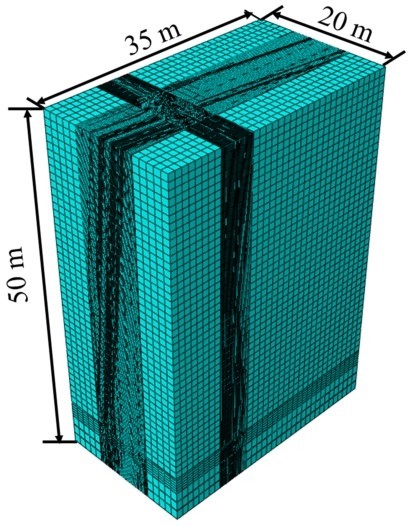
数值建模和计算通过ABAQUS的CFD模块实现,其具体求解方法可见Wani等[12] 的论文。流体域的尺寸为35 m×20 m×50 m,计算模型的阻塞比满足《建筑结构抗风设计标准》中小于3%的要求,流体域模型示意图如图1 所示。
图1 流体域数值模型和网格划分情况Fig.1 Numerical model of the fluid domain and mesh generation scheme
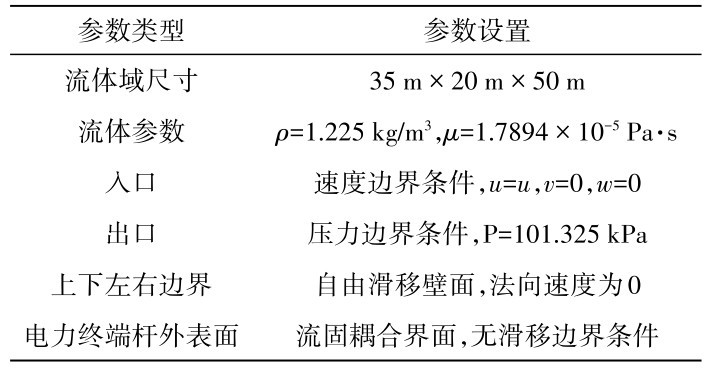
流体密度(ρ)以及粘性系数(μ)的设置参考了祝瑜哲等[13] 的论文, ρ=1.225 kg/m3 , μ=1.7894 × 10⁻⁵ Pa·s。独立平台电缆终端杆主杆形心连线中点距离入口、出口和两侧壁面的距离分别为10 m、25 m和10 m。根据《建筑结构荷载规范》,入口风速和湍流强度沿高度的分布采用指数分布率进行描述,10 m高度处的风速(u10 )的值30 m/s由上海基本风压0.55 kN/m2 换算而来,根据计算采用的B类地面粗糙度,10 m高度处的名义湍流强度(I10 )取0.14。湍流模型选用RNG k-ε湍流模型,根据闫渤文[14] 和Blocken等[15] 的研究,修正湍流参数Cμ 为0.022。流体域具体边界条件如表1 所示。
表1 流体域参数和边界条件设置Table 1 Fluid domain parameters and boundary condition settings
1.2 独立平台电缆终端杆建模和工况设置
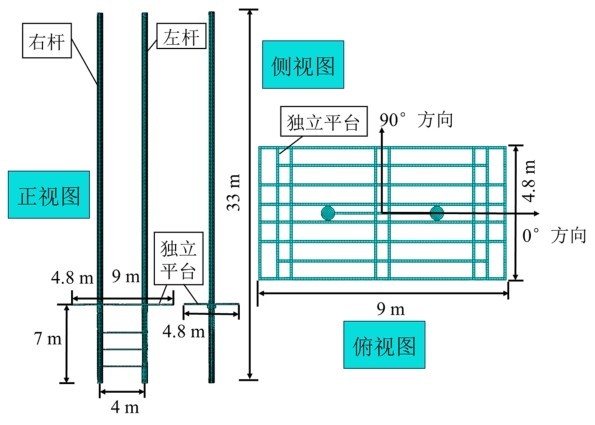
几何参数调整之前的电缆终端杆主杆为高33m,直径500 mm的正十二边形空心钢管杆,由三段钢管杆焊接而成,自下而上分别长10 m、11 m和12 m,壁厚分别为12 mm、10 mm和8 mm。几何参数调整之前的独立平台电缆终端杆数值计算模型如图2 所示。主杆和框架平台的钢材采用Q355,其他构件的钢材采用Q235。Q355和Q235的本构模型均采用理想弹塑性模型,弹性模量为210 GPa,泊松比为0.3。
图2 结构建模和网格划分Fig.2 Structural modeling and mesh generation
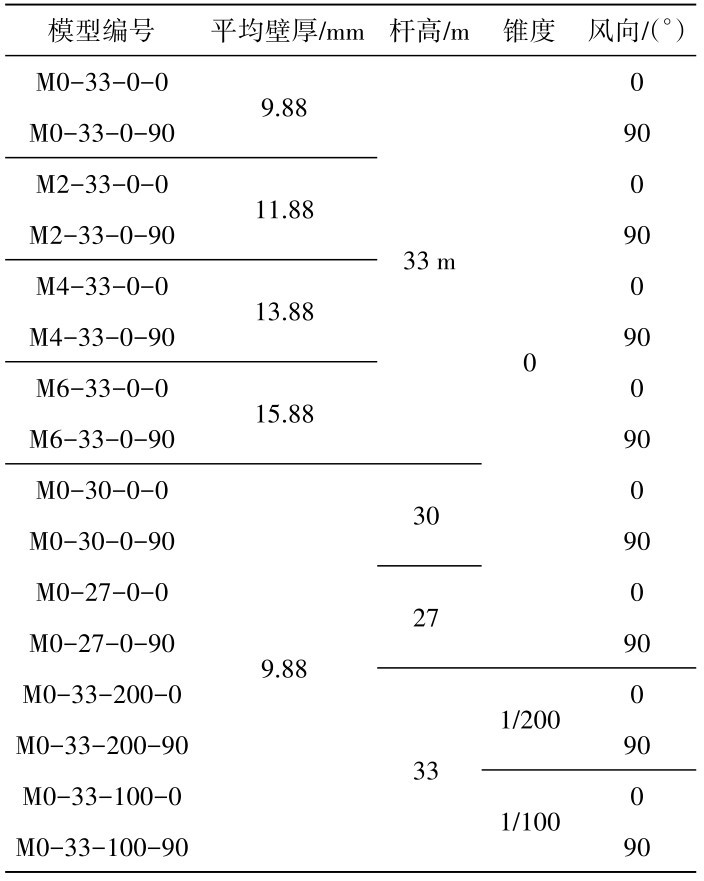
对于主杆壁厚,研究了原始壁厚(平均壁厚9.88 mm)、壁厚增加2 mm(平均壁厚11.88 mm)、壁厚增加4 mm(平均壁厚13.88 mm)和壁厚增加6 mm(平均壁厚15.88 mm)四种情况;对于主杆高度,研究了原始主杆高度(33 m)、30 m和27 m三种情况;对于主杆锥度,研究了原始锥度(0)、1:200和1:100三种情况。在研究不同锥度时,电缆终端杆的壁厚、高度和用钢量保持不变,当锥度为0时,电缆终端杆上下半径均为500 mm;当锥度为1:200时,电缆终端杆上下半径分别为429 mm和600 mm;当锥度为1:100时,电缆终端杆上下半径分别为358 mm和700 mm。风向设置为0°和90°, 0°方向为左右主杆形心连线的方向,90°方向为平行于地面并与0°方向垂直的方向,如图3 所示。具体工况设置如表2 所示。时间步长为0.01 s,共计算10 s。
表2 电缆终端杆几何参数工况设置Table 1 Geometric parameter configuration of the cable terminal pole
1.3 流体域和结构网格无关性的验证
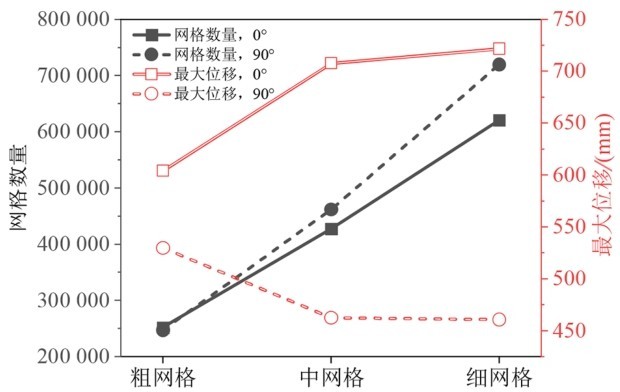
流体域全局网格尺寸设置为1[16] ,电缆终端杆外表面附近的最小网格厚度为0.025 m,在电缆终端杆外表面附近4.8 m×9 m[17] 的范围内对流体域网格进行加密。以杆高33 m,平均壁厚9.88 mm,锥度0,风向为0°和90°的工况(M0-33-0-0和M0-33-0-90)为例,进行网格无关性验证,对构件和流体域进行了三种网格划分方式。粗网格、中网格和细网格的流体域加密区网格尺寸分别为0.2 m、0.1 m和0.075 m,构件网格尺寸分别为0.2 m、0.1 m和0.075 m。网格划分结果和基本风速条件下构件的最大位移计算结果如图3 所示。
图3 不同尺寸网格的网格划分结果和电缆终端杆最大位移计算结果Fig.3 Mesh generation results for different mesh sizes and the calculated maximum displacement of the cable terminal pole
从图3 中可以看出,粗网格和中网格计算得到的最大位移值差距较大,而粗网格和细网格计算得到的最大位移值差距很小。因此在正式运算过程中采用中网格方案,网格划分情况如图1 和图3 所示,构件单元类型为 C3D8R,流体域单元类型为FC3D8。
2 结果分析
2.1 平均壁厚对风振响应的影响
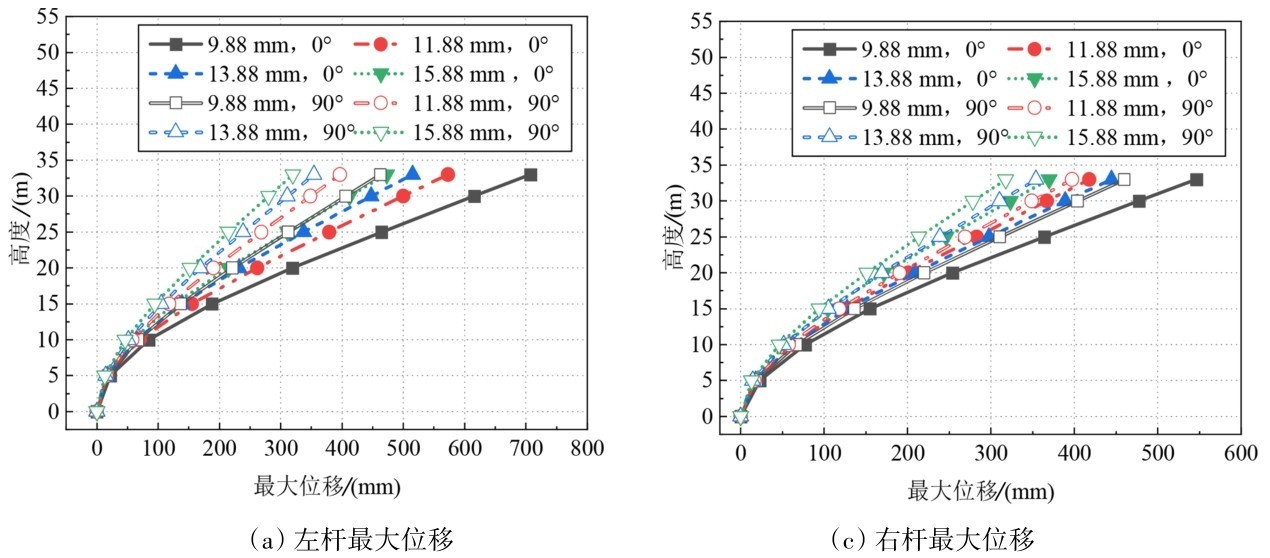
距离地面不同位置处不同平均壁厚的电缆终端杆位移响应如图4 所示。当壁厚增加2 mm时,电缆终端杆的最大位移减小至572.85 mm,已经小于《高耸结构设计规范》规定的位移最大值(660 mm)。当风向为0°时,主杆壁厚增加6 mm后,电缆终端杆左杆的最大位移从707.48 mm减小至473.10 mm,减少33.13 %;电缆终端杆右杆的最大位移从546.47 mm减小至444.61 mm,减小18.64%,增加壁厚对左杆位移的抑制效果好于右杆。当风向为90°时,电缆终端杆壁厚增加6 mm后,左杆的最大位移从462.42 mm减小至319.69 mm,减少30.87 %,右杆的最大位移从459.89 mm减小至317.71 mm,减小30.92 %,增加壁厚对左杆和右杆位移的抑制效果基本相同。
图4 不同平均壁厚主杆的位移最大值Fig.4 Maximum displacements of main poles with different average wall thicknesses
不同平均壁厚的独立平台电缆终端杆数值模型的前四阶自振频率及其对应的振型如表3 所示。随着壁厚的增加,独立平台电缆终端杆第一、二、三、四和六阶的自振频率下降,仅第五阶自振频率上升。
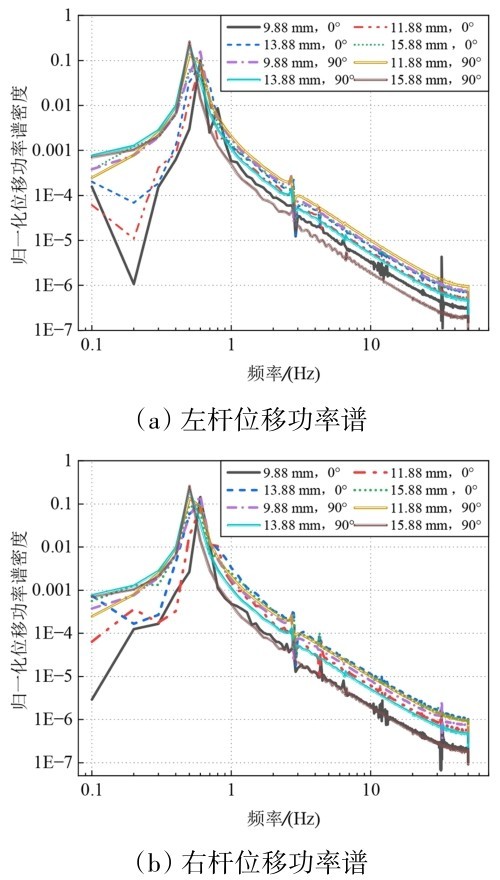
不同平均壁厚条件下电缆终端杆顶部的频域特征如图5 所示。电缆终端杆的风振响应中低阶(第一阶或第二阶)振型贡献最大。当风向为0°时,随着电缆终端杆壁厚的增加,电缆终端杆左杆和右杆的低阶模态贡献有所下降,高阶模态贡献有所上升;当风向为90°时,电缆终端杆左杆和右杆的低阶模态贡献上升,高阶模态贡献下降。
表3 不同平均壁厚独立平台电缆终端杆的自振频率与振型Table 3 Natural frequencies and mode shapes of independent platform cable terminal poles with different average wall thicknesses
图5 不同平均壁厚主杆顶部的频域特性Fig.5 Frequency-domain characteristics of the main pole top under different average wall thicknesses
2.2 杆高对风振响应的影响
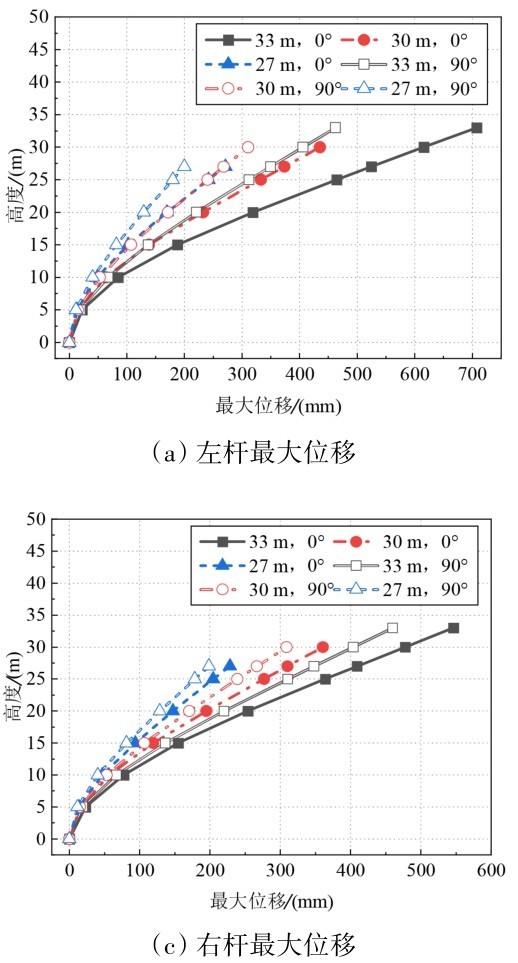
不同高度处不同壁厚的电缆终端杆位移响应如图6 所示。当杆高降低至30 m时,电缆终端杆的最大位移减小至435.56 mm,已经小于《高耸结构设计规范》规定的位移最大值(600 mm)。当杆高从33 m降低至27 m,风向为0°时,电缆终端杆左杆的最大位移从707.48 mm减小至271.26 mm,减小61.66 % ;右杆的最大位移从546.47 mm减小至228.34 mm,减小58.22 %,降低杆高对左杆位移的抑制效果与对右杆位移的抑制效果相差不大。风向为90°时,电缆终端杆左杆的最大位移从462.42 mm 减小至 199.96 mm,减小 56.76 % ,减小58.42 % ;右杆的最大位移从459.89 mm减小至198.61 mm,减小56.81 %,不同风向条件下降低杆高对电缆终端杆位移的抑制效果相差不大。
图6 不同杆高主杆的位移最大值Fig.6 Maximum displacements of main poles with different pole heights
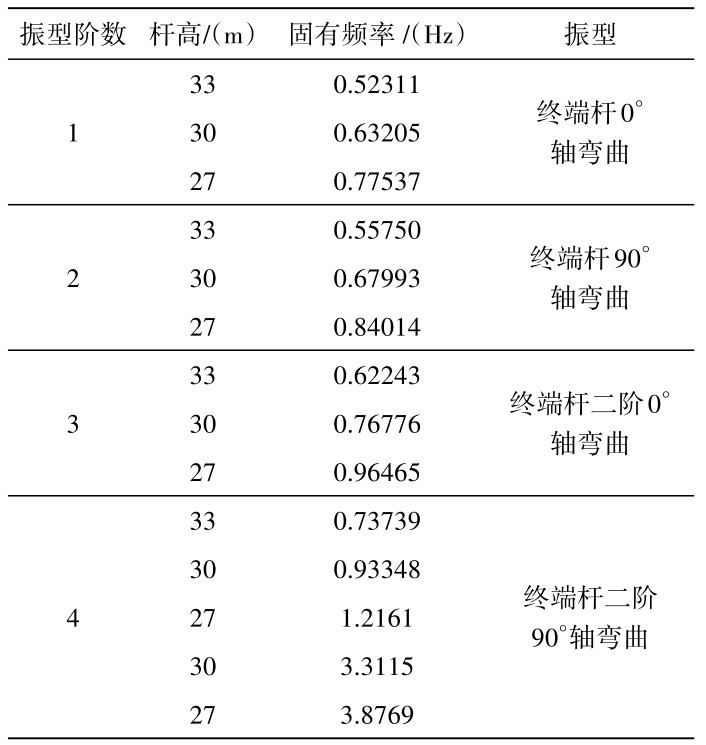
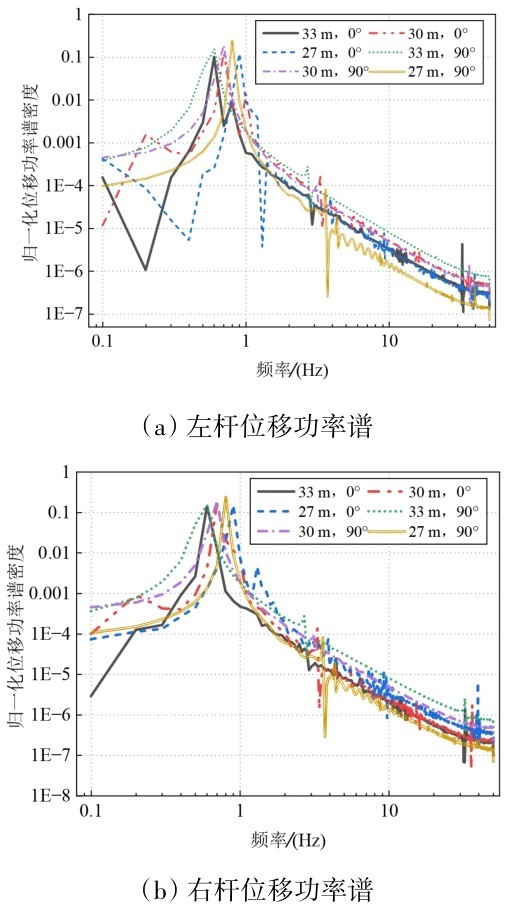
由表4 可知,随着杆高的降低,主杆相同阶数的自振频率上升。不同杆高条件下主杆顶部的频域特征如图7 所示。当风向为0°时,对于左杆,不同振型在风振响应中的贡献变化不大;对于右杆,低阶振型的贡献减小,高阶振型的贡献更加明显;当风向为90°时,电缆终端杆低阶振型在风振响应中的贡献随着杆高的降低而增大,高阶振型的贡献则随着杆高的降低而减小。
表4 不同杆高独立平台电缆终端杆的自振频率与振型Table 4 Natural frequencies and mode shapes of independent platform cable terminal poles with different pole heights
图7 不同杆高主杆顶部的频域特性Fig.7 Frequency-domain characteristics of the main pole top under different pole heights
2.3 锥度对风振响应的影响
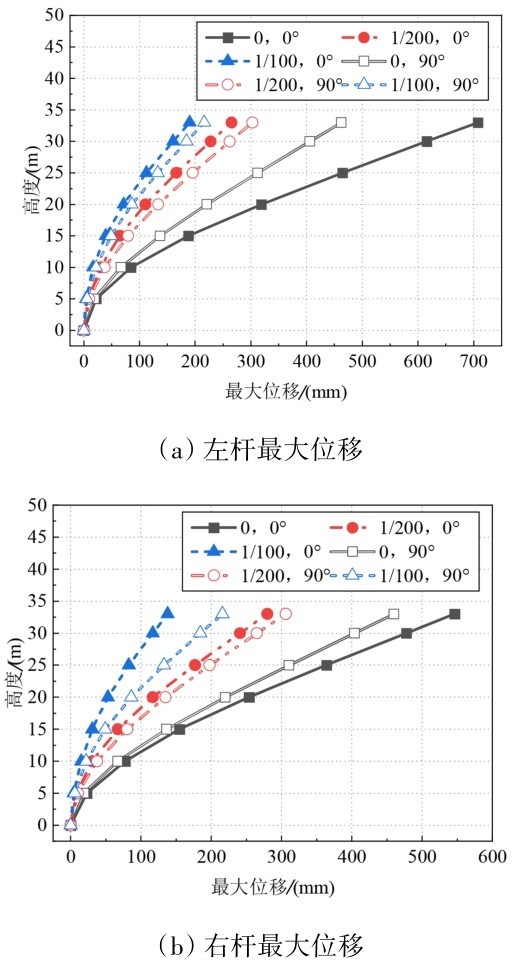
不同高度处不同锥度条件下电缆终端杆的位移响应如图8 所示。将电缆终端杆锥度调整为1/200时,电缆终端杆在基本风速条件下的最大位移值减小至302.66 mm,已经小于《高耸结构设计规范》规定的位移最大值(660 mm),表明增大电缆终端杆锥度可以有效抑制独立平台电缆终端杆的风致振动。随着电缆终端杆的锥度从0增大至1/100,风向为0°时,电缆终端杆左杆的最大风致位移从707.48 mm减小至190.10 mm,减小73.13 %;右杆的最大位移从546.47 mm减小至138.07 mm,减小74.74 %,与壁厚和杆高不同,锥度对右杆风致幅值的影响大于左杆。当风向为90°时,左杆的最大位移从462.42 mm减小至216.45 mm,减小53.19 %;右杆的最大位移从459.89 mm减小至215.98 mm,减小53.04 %,相比于风向为0°,电缆终端杆锥度对风向为90°时风致位移的抑制效果更弱。
图8 不同锥度主杆的位移最大值Fig.8 Maximum displacements of main poles with different pole tapers
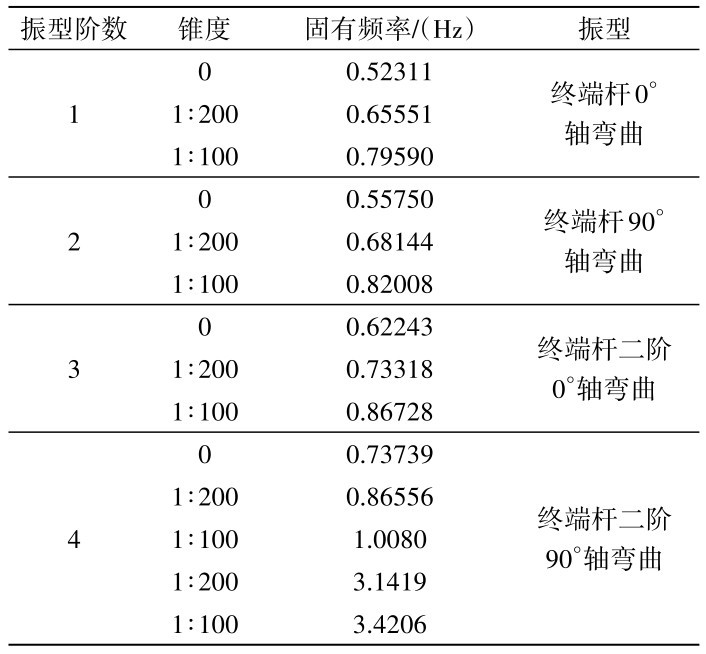
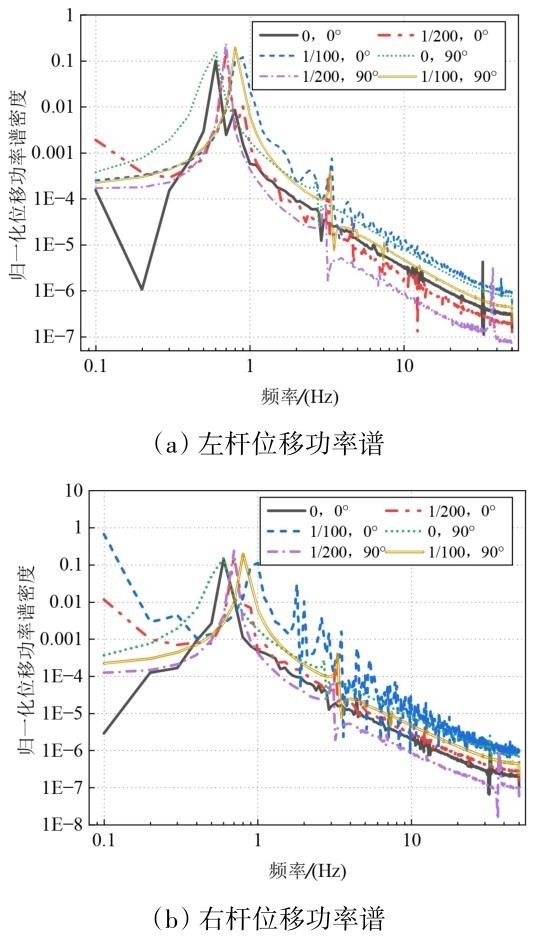
由表5 可知,独立平台电缆终端杆相同阶数的自振频率随锥度的增大而上升。不同锥度条件下电缆终端杆的频域特征如图9 所示。当风向为0°时,电缆终端杆左杆的模态的在风振响应中的贡献变化不大,右杆低阶振型的贡献减小,高阶振型的贡献增大;当风向为90°时,电缆终端杆低阶和高阶模态贡献变化不明显。
表5 不同锥度独立平台电缆终端杆的自振频率与振型Table 5 Natural frequencies and mode shapes of independent platform cable terminal poles with different pole tapers
图9 不同锥度电缆终端杆的频域特性Fig.9 Frequency-domain characteristics of the main pole top under different pole tapers
3 结论
(1)增加电缆终端杆壁厚、降低主杆杆高和增加主杆锥度均可以有效降低电缆终端杆在基本风速条件下的位移。
(2)当风向为0°时,增加壁厚对电缆终端杆左杆位移的抑制作用强于右杆,降低杆高对左杆位移的抑制作用与对右杆的抑制作用基本相同,增大锥度对左杆位移的抑制作用弱于右杆。在风向为90°时,改变几何参数对左杆和右杆位移的抑制作用基本相同。
(3)在风向为0°时,低阶振型的贡献随着壁厚、锥度的增大和杆高的降低而减小,高阶振型的贡献随着壁厚和锥度的增大而增大,随杆高的降低而增大;在风向为90°时,几何参数对低阶和高阶振型在风振响应中贡献的影响与风向为0°时相反。
图1 流体域数值模型和网格划分情况Fig.1 Numerical model of the fluid domain and mesh generation scheme 表1 流体域参数和边界条件设置Table 1 Fluid domain parameters and boundary condition settings 图2 结构建模和网格划分Fig.2 Structural modeling and mesh generation 表2 电缆终端杆几何参数工况设置Table 1 Geometric parameter configuration of the cable terminal pole 图3 不同尺寸网格的网格划分结果和电缆终端杆最大位移计算结果Fig.3 Mesh generation results for different mesh sizes and the calculated maximum displacement of the cable terminal pole 图4 不同平均壁厚主杆的位移最大值Fig.4 Maximum displacements of main poles with different average wall thicknesses 表3 不同平均壁厚独立平台电缆终端杆的自振频率与振型Table 3 Natural frequencies and mode shapes of independent platform cable terminal poles with different average wall thicknesses 图5 不同平均壁厚主杆顶部的频域特性Fig.5 Frequency-domain characteristics of the main pole top under different average wall thicknesses 图6 不同杆高主杆的位移最大值Fig.6 Maximum displacements of main poles with different pole heights 表4 不同杆高独立平台电缆终端杆的自振频率与振型Table 4 Natural frequencies and mode shapes of independent platform cable terminal poles with different pole heights 图7 不同杆高主杆顶部的频域特性Fig.7 Frequency-domain characteristics of the main pole top under different pole heights 图8 不同锥度主杆的位移最大值Fig.8 Maximum displacements of main poles with different pole tapers 表5 不同锥度独立平台电缆终端杆的自振频率与振型Table 5 Natural frequencies and mode shapes of independent platform cable terminal poles with different pole tapers 图9 不同锥度电缆终端杆的频域特性Fig.9 Frequency-domain characteristics of the main pole top under different pole tapers